Milne Shines at Education Forum that King Skips
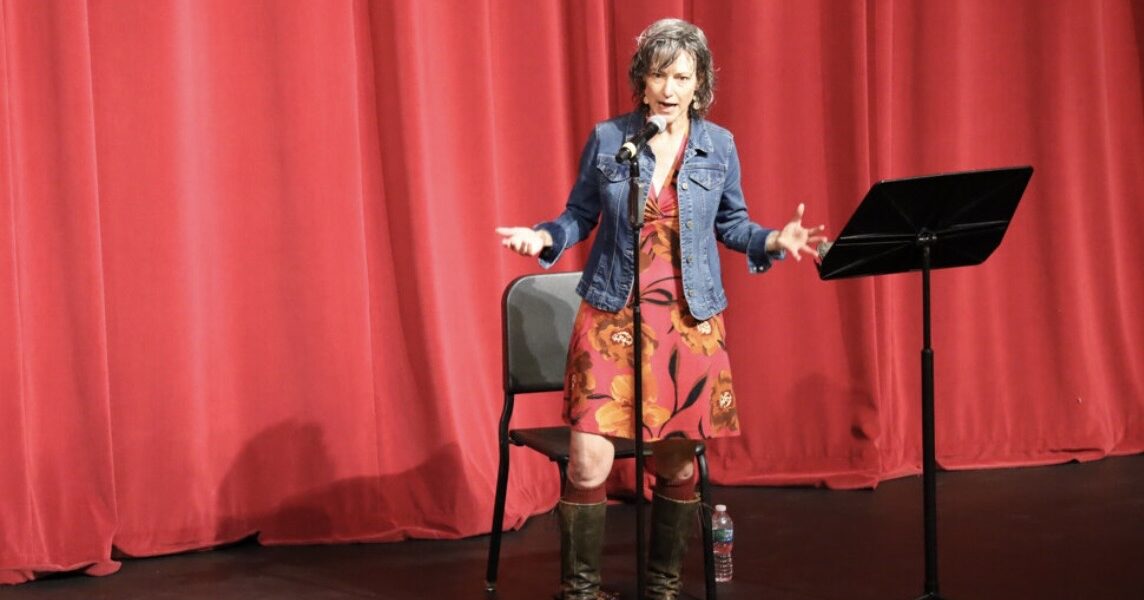
Michelle Milne, Democratic candidate for State Representative- District 49, was given the opportunity to express her views on the state of Public Education in Indiana. Goshen residents are aware of the negative financial impact of Indiana Senate Bill 1 (SB 1) on Goshen’s Public School System. The Bill reduced Goshen’s revenue for education by $3.8 million in 2026 with greater reduction amounts coming in 2027 and beyond.
The event was held at Goshen High School’s auditorium with over 150 people present on Tuesday night, September 29. It was organized and hosted by Bruce Stahly and Diane Woodworth, both of whom are former school superintendents. The event was originally intended to be a debate between Milne and the incumbent
Representative, Republican Joanna King.
King had originally agreed to participate in the debate, but stated a scheduling conflict had arisen. She was offered an alternative date, but never responded back to either of these former superintendents. Milne had the stage to herself and was presented with a series of questions by Stahly and Woodworth.
The following commentary summarizes Milne’s answers as to what she would emphasize if elected in the upcoming November elections.
The Role of Public Education in Democracy
The first question presented asked Milne to define what the role of Public Education was in a Democracy. She responded that first and foremost, it is written as a mandate in the Indiana State Constition. Strong Public Education, starting at an early age, is also the basis for a strong community. Education is an equalizer
that offers all students the training and resources to become successful as machinists, doctors, nurses, business leaders … any profession they wish to pursue in a democratic government.
Importance of Adequate Funding
In addressing the current shortage of funds, Milne stated, “We need to look down the road 20-30 years, not just towards the next budgeting cycle.”
Adequate funding at the state level allows school systems to provide the necessary resources for students to succeed. It also helps to attract and retain talented, devoted teachers. Currently, Indiana ranks 38th out of 50 states in teacher compensation. Michigan, just a few miles away, pays more. If more teachers could be hired, class sizes could be reduced allowing more personal time with each student. The budget cuts mandated by Indiana’s government have put increased pressure on all local school boards and put them in a tight position. “We need to pay teachers like we want to keep them,” Milne stated.
The Voucher System for Private Schools
Vouchers for private schools are taxpayer funded. Families must apply to the desired school and meet Indiana residential as well as individual school admission requirements. Vouchers amounts are typically $6,000-$8,500 per student annually. Families are then responsible for any amounts due beyond the voucher stipend. Even with a voucher, financially challenged families still can’t afford private schools, making a strong public school system extremely important.
The difference between public schools and private schools is that private schools are not held to the same accountability standards as public schools. They are not required to offer special education or speech therapy classes. Private schools are also not subject to oversight by local taxpayers or elected school board officials.
Milne said that, “Families should decide what’s best for their child. But we can’t afford to keep subsidizing wealthy families when we aren’t meeting our constitutional obligation to fund the public schools that serve the majority of Indiana’s youth.”
The program concluded with a brief question and answer period. The audience was appreciative and gave all presenters a generous round of applause. Candidate Milne then made herself available for individual conversations.