Follow the Money in District 49
When I want to understand what influences a politician, I start with campaign contributions. Who’s donating, how much they’re giving, and which industries or organizations are investing in a candidate’s campaign can offer valuable insight into the interests surrounding them. Contributions don’t automatically determine how a politician votes, but they’re an important part of the picture. If we want to understand the forces shaping public policy, we should pay attention not only to what politicians say, but also to who helps fund their campaigns.
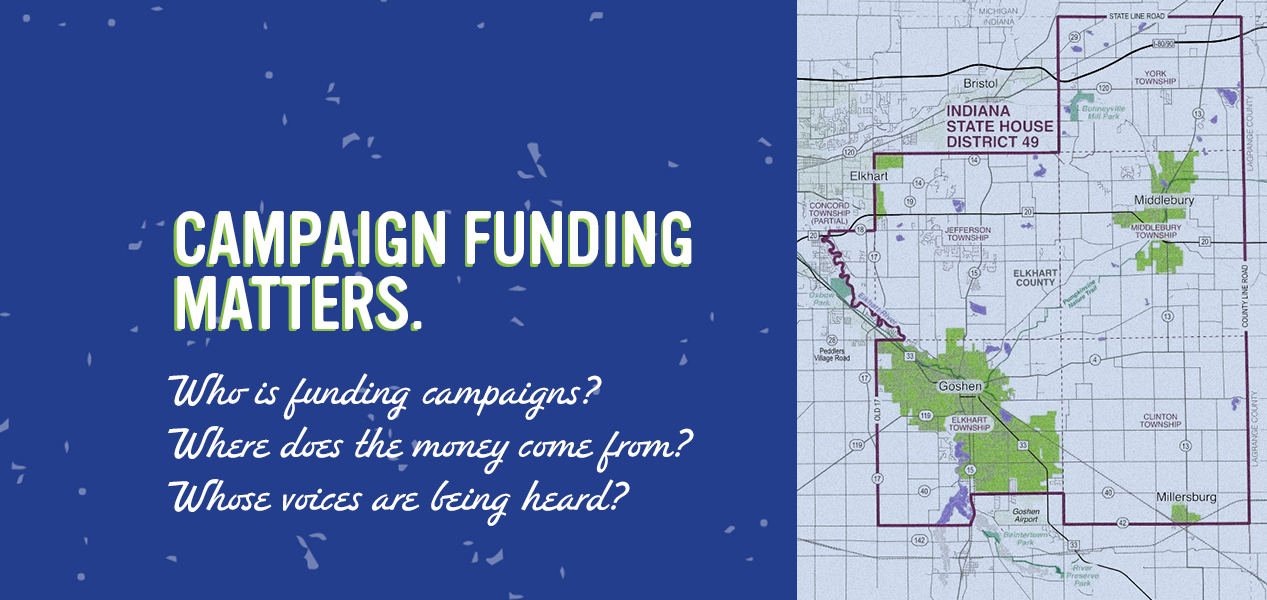
Campaign finance reports are public. They show who funds a candidate’s campaign, whether that money comes from individuals or organizations, and where those contributions originate. The Pre-Primary report, covering January 1 through April 10, 2026, and the Pre-Election report, covering April 11 through October 9, 2026, provide a picture of campaign fundraising in Indiana House District 49 and reveal a striking difference between the two candidates.
Starting with Michelle Milne:
Between January 1 and October 9, 2026 Milne had 200 total contributions to her campaign, 199 came from individuals, representing at least 143 individual donors. That includes at least 72 additional donors behind the $7,179.52 in unitemized donations, since each gave less than $100.00 total. The only other contribution was $1,000 from the Elkhart County Democratic Central Committee. Her campaign received no contributions from corporations or PACs. Milne’s support is also overwhelmingly local: at least 108 contributions came from Goshen, where Milne lives, three from Middlebury, and four from Elkhart, while nine came from outside Indiana. Because unitemized donations don’t identify individual contributors or their locations, the actual number of local donors may be higher.
Now let’s look at Joanna King:
Between January 1 and October 9, 2026 King had 55 contributions, 52 of which came from political action committees, organizations, and groups; while three came from individuals. Only one contribution came from Goshen, and none came from Middlebury, where King lives. Nineteen contributions, just under a quarter of the total, came from outside Indiana. Notably, King also has zero unitemized donations, which means not a single individual donated less than $100.00 total to her campaign.
Here’s the comparison at a glance:
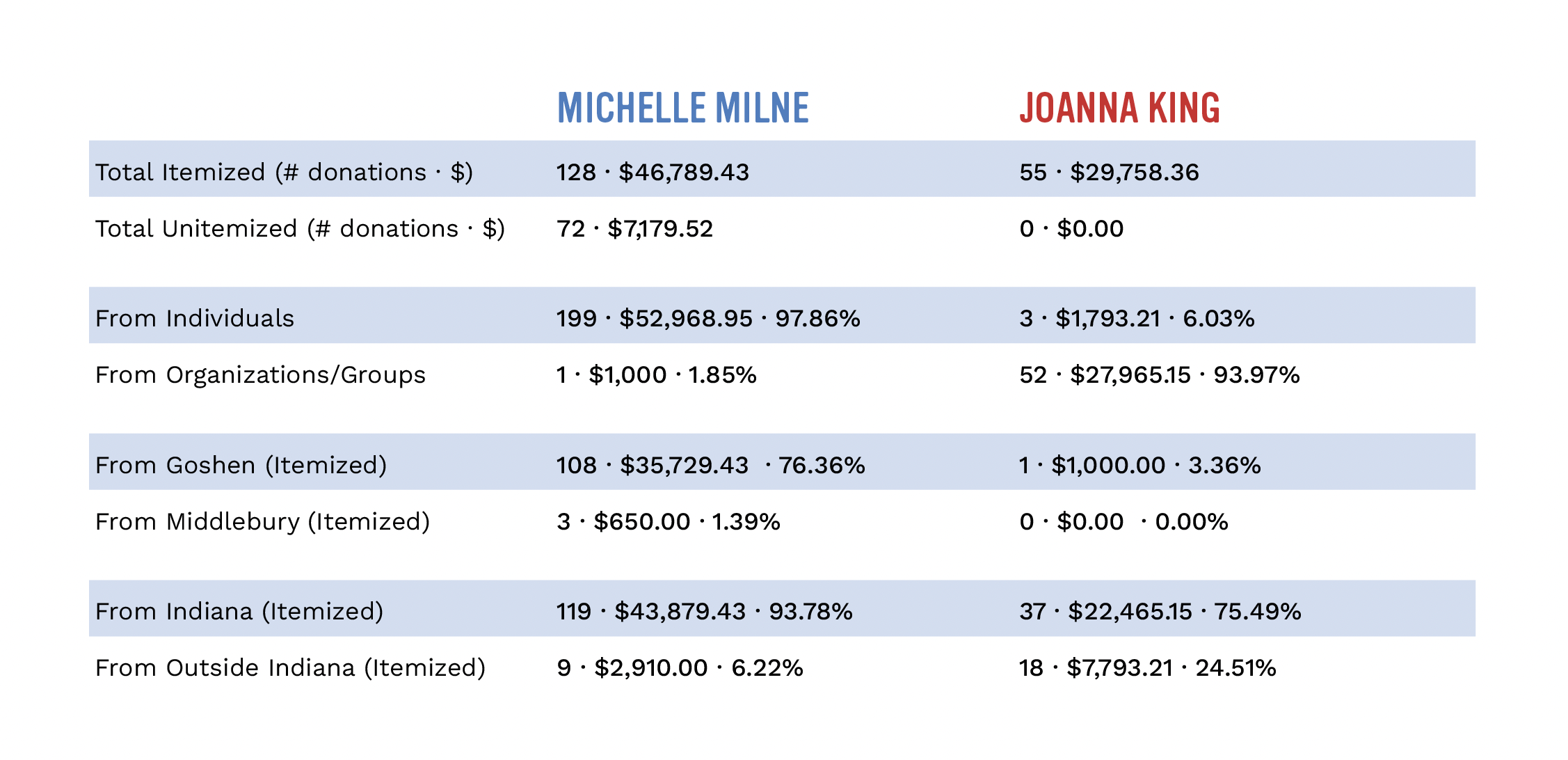
What do I take away from this? Milne’s campaign is funded overwhelmingly by individuals, with substantial support from our own community in district 49. In contrast, King’s campaign relies on political action committees, organizations, and groups, and a much larger share of her contributions comes from outside Indiana.
Campaign funding matters. Running for office takes money, and candidates build relationships with the people and organizations that help fund their campaigns. When most of your support comes from local residents, your campaign has deep roots in the community. When most of it comes from political action committees and organizations, it raises a question: whose priorities will carry the most weight when difficult decisions come?
These figures come from the Pre-Primary and Pre-Election reports that can be found at https://campaignfinance.in.gov. Before you vote, follow the money. Look at who is funding each campaign, where that money comes from, and what those contributions might tell you about whose voices are being heard.
By Dan Barwick, Goshen Dems Volunteer
Early voting is open now.
Bring your people to the polls. For more information on when and where you can vote: