
Trash Fees Coming to Goshen?
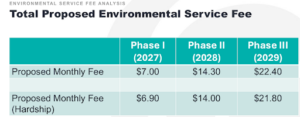
On July 10, the Mayor, City Council, and department heads met for an information session with a representative from accounting firm Baker Tilly to discuss the possibility of enacting a new environmental service fee for Goshen residents. This fee, which as proposed would be a monthly charge of $22.40 per household once fully phased in, would be a charge for the collection of residential trash and recycling, brush and yard waste, and for the environmental services center, which is currently a service that the City provides to residents for free, at a cost of approximately $2.8 million a year. Mayor Gina Leichty (D) opened this meeting by saying “This is a conversation that nobody wants to have, but is absolutely necessary.” To understand why this new fee might be absolutely necessary now when it wasn’t before, we have to look at changes that the state made to property taxes and municipal finance in 2025.
In 2025 the Indiana Legislature passed Senate Enrolled Act 1 (SEA1), which brought sweeping changes to how property taxes and municipal finance work across the state, with a net effect of drastically reducing municipal tax revenue. For Goshen, this could mean a loss of annual revenue of $13.2 million, or approximately 38% of revenue, by the time the law is fully phased in in 2029. Because SEA1 limits municipal governments’ ability to levy taxes to fund their operations, cities are being forced to make up for this lost revenue with new fees and service cuts. Goshen has already imposed a new wheel tax, and has been forced to make some service cuts, including the permanent closure of the Shanklin Pool and the cancellation of a new fire station. At the July 10 information session, Goshen City Council President Brett Weddell (R) and Councilman Donald Riegsecker (R) correctly observed that this shift away from taxes and towards fees is regressive, and will push more of the burden of funding municipal government onto those who can least afford it, for the benefit of wealthy owners of luxury homes and industrial land uses, like factories and data centers.
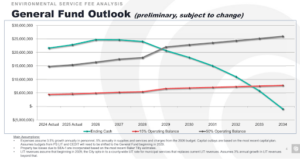
As shown in the graph above provided by Baker Tilly, the city currently has a healthy cash reserve of over 50% of annual operating costs, but they warned that without changes Goshen would burn through its cash reserves and dip below the “danger zone” line of 15% of operating costs by 2033, with a steep downward trajectory. Some Councilors, including Riegsecker and Councilman Doug Nisly (R), suggested that the impact of SEA1 might not be as bad as anticipated, and went as far as to suggest that the city shouldn’t adopt changes until cash reserves reached the danger zone. They seem to be holding out hope that the state is going to fix the problems with SEA1.
Mayor Leichty is less optimistic, saying “We don’t anticipate anyone is coming to save us. We don’t anticipate the state changing course.” Indeed, a bipartisan group of Mayors and City and County Councilors and Commissioners urged the state to hold an emergency session to fix the problems with SEA1 and resolve this municipal budget crisis, but the Republican supermajority at the statehouse chose instead to use their emergency session in a failed attempt at mid-cycle redistricting to gerrymander the state at the behest of Donald Trump. City Clerk Treasurer Richard Aguirre (D) pointed out that Governor Mike Braun (R) is advocating for going even farther, possibly eliminating property taxes altogether. The Governor and his allies at the statehouse seem to believe that they can take credit for cutting the taxes that municipalities rely on (there have been no calls to reduce the taxes and fees that fund the state government) while blaming local leaders for the consequences of those cuts.
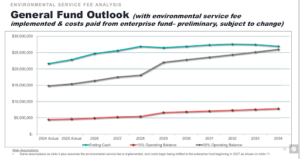
In light of this troubling financial situation created by the state, imposing this fee would cover the full cost of trash, recycling, and brush collection services when it is fully phased in and would leave the city in a much better financial position, keeping cash reserves above the recommended 50% of operating costs. Nobody likes paying more for the same services that they had before, and the concerns that this fee is regressive are valid. Unfortunately, this is an unavoidable consequence of the change from a tax-supported model to a fee-supported model being imposed by the state. As Councilwoman Megan Peel (D) asked, “If not this, what?” If the Council fails to pass the proposed environmental service fee, they may be forced to consider other fees, or to implement deeper service cuts, including to roads and sidewalks, emergency services like police and fire, and to quality of life investments like parks, trails, and the arts. Even if passed, this fee would raise less than $3 million a year, while the city is working to plug a $13.2 million hole created by SEA1. Unfortunately the state has left us in a position where we may be forced to have more conversations that nobody wants to have, but which are absolutely necessary.
For more information, you can view the full slideshow presented by Baker Tilly here.
Author: Kyle Richardson
Editor: Ron Altenhof
Contact Local Legislators
Please call your state legislators and urge them to fix or repeal SEA1. If you live in Goshen your state legislators are Joanna King (R) (317-232-9657 ) and Blake Doriot (R) (800-382-9467).